

In a major announcement that could redefine administrative training in the state, Telangana Chief Minister Revanth Reddy unveiled plans to bring Harvard to Hyderabad through a formal collaboration between the state’s premier training institution and Harvard University. The proposal, revealed during the closing ceremony of Group-1 and Group-2 officers’ training, signals a significant shift in how civil servants in Telangana will receive executive education.
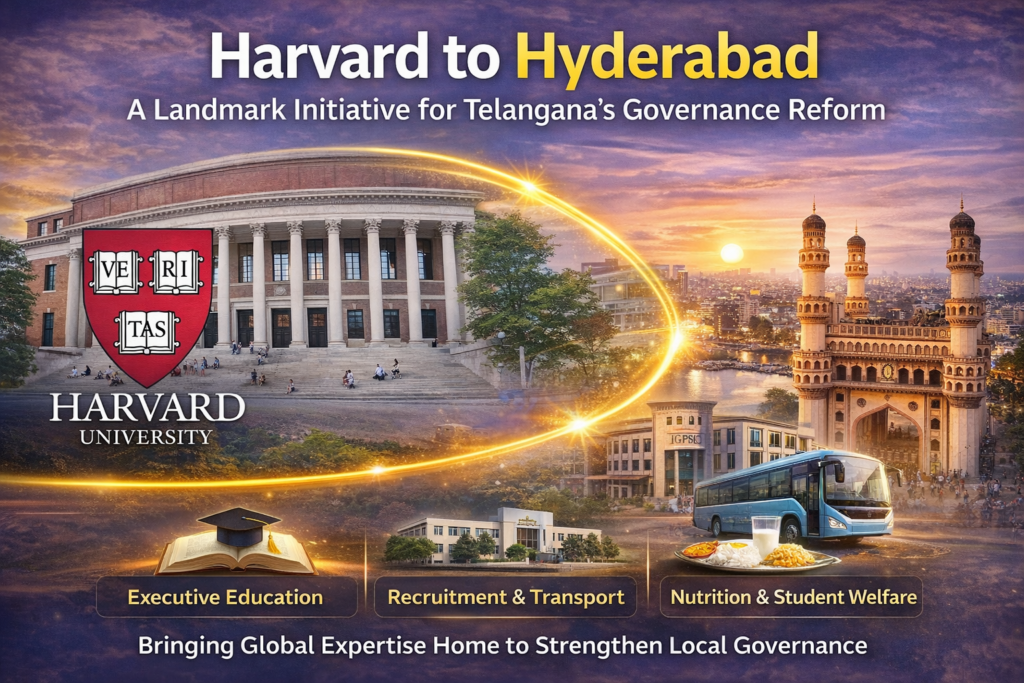
The idea behind Harvard to Hyderabad is simple yet ambitious: instead of sending officers abroad for advanced leadership programs, global faculty from Harvard will conduct executive education programs in Hyderabad itself. The move aims to expand access, reduce costs, and ensure that more officers benefit from world-class governance training without leaving the country.
A Strategic Partnership: MCRHRD and Harvard
The Chief Minister stated that discussions are underway to formalize an agreement between the Marri Chenna Reddy Human Resource Development Institute (MCRHRD) and Harvard University.
Under this initiative, Harvard faculty members are expected to visit Hyderabad to conduct executive education sessions tailored for senior government officials. According to officials present at the event, this partnership would allow Telangana officers to gain exposure to global governance models, policy innovation strategies, and administrative best practices.
The Chief Minister explained that many officers face financial and logistical challenges when attempting to enroll in international programs. By bringing Harvard to Hyderabad, the government hopes to democratize access to high-level training.
Harvard’s executive programs are globally recognized for leadership development, public policy design, and institutional management. Integrating such expertise into Telangana’s administrative training framework could enhance decision-making quality and policy implementation standards.
For reference on global executive programs, readers may visit:
Reforming Public Service Recruitment and Training
During the ceremony, the Chief Minister also addressed recruitment reforms. He criticized the previous administration, stating that not a single Group-1 notification was successfully completed over the past decade.
He emphasized that after assuming office, the government undertook reforms within the Telangana Public Service Commission. Measures were introduced to ensure greater transparency in examinations and to prevent paper leaks or malpractice.
The Chief Minister noted that strict safeguards have been implemented to protect examination integrity. According to him, restoring trust in the recruitment system was essential to rebuild confidence among aspirants and their families.
The Harvard to Hyderabad initiative is being positioned as a continuation of these reforms—shifting focus not just to fair recruitment but also to high-quality training after selection.
Officers Urged to Serve with Integrity and Compassion
Addressing newly trained officers, the Chief Minister urged them to remember their responsibility as representatives of the government. He encouraged them to serve citizens with dedication and ethical conduct.
In an emotional note, he advised officers to take care of their parents and families while fulfilling their public duties. He highlighted that civil servants are often viewed as the face of governance at the grassroots level and must balance professional excellence with personal values.
The message was clear: administrative power must be matched by humility and accountability.
The Harvard to Hyderabad model, he suggested, would not only enhance technical skills but also broaden perspectives on inclusive governance.
Electric Buses for Government School Students: A New Transport Plan
In addition to administrative reforms, the Chief Minister issued key directives related to government school students’ transportation.
Officials have been instructed to study the feasibility of introducing electric buses for government school students. The plan proposes a pilot project in selected constituencies outside the core urban region. Each mandal under the pilot would receive structured transportation support along with essential facilities.
The proposal aligns with broader sustainability goals, promoting environmentally friendly mobility solutions while improving school access for rural students.
Experts suggest that electric buses could reduce long-term fuel costs and minimize environmental impact. For background on electric mobility in India, readers can refer to:
Strengthening the Breakfast Scheme with Milk Supply
Another directive focused on the state’s breakfast program in government schools. The Chief Minister instructed officials to ensure that milk becomes a mandatory component of the scheme.
Milk procurement is expected to be coordinated through Vijaya Dairy, supporting local dairy networks while improving nutritional standards.
Education and nutrition experts widely acknowledge that protein intake plays a critical role in cognitive development and concentration among children. By integrating milk into the breakfast scheme, the government aims to strengthen child health outcomes.
Key Announcements at a Glance
| Initiative | Objective | Implementation Plan | Expected Impact |
|---|---|---|---|
| Harvard to Hyderabad | Global executive education for officers | Partnership between MCRHRD and Harvard | Improved governance skills |
| Recruitment Reforms | Transparent Group-1 & Group-2 exams | Strict exam safeguards | Restored public trust |
| Electric Bus Study | Student transportation upgrade | Pilot in selected mandals | Better school access, lower emissions |
| Breakfast Milk Addition | Improved student nutrition | Procurement via Vijaya Dairy | Enhanced child health |
Why Harvard to Hyderabad Matters
The Harvard to Hyderabad initiative is not merely symbolic. It reflects an attempt to internationalize governance education within Telangana. By reducing dependency on overseas travel for executive learning, the government aims to:
- Expand training access
- Reduce public expenditure
- Encourage knowledge transfer at scale
- Build a globally aware administrative system
Public administration experts often emphasize that leadership training directly influences policy outcomes. If executed effectively, the Harvard to Hyderabad collaboration could serve as a model for other Indian states.
Broader Governance Vision
The announcements collectively suggest a governance model built around three pillars:
- Transparent recruitment
- World-class training
- Citizen-focused welfare initiatives
By combining recruitment reforms with advanced executive education, the administration aims to strengthen both entry-level integrity and senior-level decision-making capacity.
The electric bus proposal and breakfast scheme expansion indicate parallel efforts in education and sustainability.
While detailed timelines are yet to be released, officials confirmed that feasibility studies and formal agreements are in progress.
Conclusion
The announcement of Harvard to Hyderabad marks a significant step in Telangana’s administrative evolution. By seeking collaboration with Harvard University, the government aims to elevate training standards for civil servants without requiring international relocation.
Simultaneously, reforms in recruitment transparency, student transport, and nutrition reflect broader governance priorities.
Whether the initiative transforms public administration as envisioned will depend on timely implementation and sustained institutional support. However, the proposal has already sparked discussion about how global knowledge can be localized to serve regional needs.
For More Updates
For Latest Finance News Visit:-
https://bignixhub.com/category/finance/
For Latest Gold & Silver Rates Visit:-
https://bignixhub.com/gold-silver-rates/
Frequently Asked Questions (FAQ)
1. What is the Harvard to Hyderabad initiative?
It is a proposed collaboration where Harvard faculty would conduct executive education programs in Hyderabad for Telangana government officers.
2. Which institution in Telangana will partner with Harvard?
The training is expected to be conducted through the Marri Chenna Reddy Human Resource Development Institute (MCRHRD).
3. Why is this initiative important?
It allows officers to access globally recognized leadership programs without traveling abroad, reducing costs and increasing participation.
4. What other announcements were made?
The Chief Minister announced recruitment reforms, electric bus feasibility studies for government schools, and mandatory milk inclusion in the breakfast scheme.
5. Has the agreement been finalized?
Officials indicated that discussions are ongoing, and formal agreements are expected after further procedural steps.
Disclaimer
This article is for informational purposes only. The details are based on official statements made during a public event. Implementation timelines and program specifics may change as per government decisions. Readers are advised to refer to official government releases for confirmed updates.