

The proposed Hyderabad to Amaravati High-Speed Rail project has sparked fresh discussions across Telangana and Andhra Pradesh. If approved, the Hyderabad to Amaravati High-Speed Rail corridor could reduce travel time between the two cities to just a few hours, improving business, connectivity, and regional growth. Officials say early studies are underway, and detailed planning will decide the next steps.
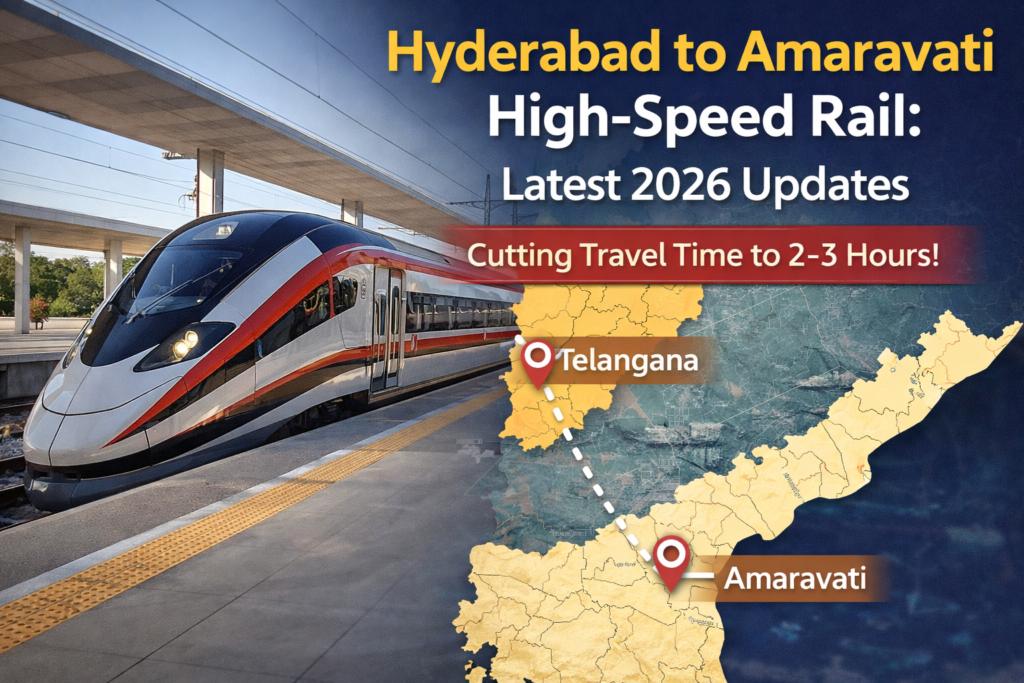
The project is still at a preliminary stage. However, the idea of a modern bullet train connecting Hyderabad and Amaravati has already created strong public interest. Here is a clear and simple breakdown of what is known so far.
Why Hyderabad to Amaravati High-Speed Rail Matters
Hyderabad is one of India’s leading IT and business hubs. Amaravati is being developed as the capital city of Andhra Pradesh. A direct high-speed rail line between these two cities would improve movement of people, professionals, and investors.
Currently, travel between Hyderabad and Amaravati by road takes around 5 to 6 hours depending on traffic. Rail services are available but not high-speed. A dedicated Hyderabad to Amaravati High-Speed Rail system could cut this time significantly.
High-speed rail projects in India are being guided by the National High Speed Rail Corporation Limited (NHSRCL), which is implementing the Mumbai–Ahmedabad corridor. You can learn more from the official NHSRCL website:
https://nhsrcl.in
The success of such projects in other regions may influence future corridors like Hyderabad to Amaravati High-Speed Rail.
Proposed Route and Speed Details
Initial discussions suggest the corridor may cover around 250 km. The exact alignment, stations, and land requirements will be finalized after a Detailed Project Report (DPR).
If implemented, trains could operate at speeds between 200 km/h to 300 km/h, depending on design standards. This would reduce travel time to nearly 2 to 3 hours.
Below is a basic comparison table:
| Mode of Travel | Average Travel Time | Estimated Speed | Comfort Level |
|---|---|---|---|
| Road (Car/Bus) | 5–6 hours | 60–80 km/h | Moderate |
| Conventional Train | 4–5 hours | 80–110 km/h | Moderate |
| Proposed High-Speed Rail | 2–3 hours | 200–300 km/h | High |
This shows how Hyderabad to Amaravati High-Speed Rail could transform daily travel.
Economic Impact on Telangana and Andhra Pradesh
The Hyderabad to Amaravati High-Speed Rail project is expected to bring economic benefits to both states. Faster travel improves business meetings, tourism, education access, and trade.
Some possible benefits include:
- Boost in real estate activity near stations
- Growth of commercial hubs
- Increased job creation during construction
- Better connectivity for IT and government sectors
High-speed rail projects are often supported by central government planning bodies like NITI Aayog. More information on infrastructure planning can be found at:
https://www.niti.gov.in
Improved connectivity may also support Andhra Pradesh’s capital development plans. Details about Amaravati development are available through the Andhra Pradesh Capital Region Development Authority (APCRDA):
https://crda.ap.gov.in
These developments could increase regional cooperation between Telangana and Andhra Pradesh.
Project Status and Government Plans
At present, the Hyderabad to Amaravati High-Speed Rail project is under discussion. Authorities are reportedly studying feasibility aspects including:
- Land acquisition requirements
- Estimated project cost
- Environmental impact
- Passenger demand analysis
- Funding models
A Detailed Project Report (DPR) will play a major role in deciding whether the project moves forward. The DPR includes technical surveys, cost estimates, and financial planning.
Infrastructure projects of this scale require coordination between state governments and the central government. Funding could involve a mix of government support, loans, and possible international collaboration.
The timeline will depend on approvals and financial closure.
Challenges Ahead
While the Hyderabad to Amaravati High-Speed Rail plan looks promising, there are challenges:
- High construction cost
- Land acquisition concerns
- Environmental clearances
- Financial viability
- Inter-state coordination
India’s first bullet train project between Mumbai and Ahmedabad has faced delays due to land and cost issues. This shows that large infrastructure projects require careful planning.
However, if executed well, Hyderabad to Amaravati High-Speed Rail could become a major infrastructure milestone in South India.
What This Means for Citizens
For regular travelers, professionals, and students, faster travel means more flexibility. Business leaders could travel in the morning and return the same day. Government officials may benefit from quicker coordination between the two states.
Improved rail connectivity can also reduce road traffic and lower fuel usage, contributing to better environmental outcomes.
If ticket pricing remains reasonable, the Hyderabad to Amaravati High-Speed Rail corridor may become a preferred travel option.
Frequently Asked Questions (FAQ)
1. Is Hyderabad to Amaravati High-Speed Rail officially approved?
No official final approval has been announced yet. Feasibility studies and DPR preparation are expected to guide the decision.
2. How long will the journey take?
If implemented at high speed, travel time could reduce to around 2 to 3 hours.
3. What will be the distance?
The proposed distance is estimated at around 250 km, but final alignment may vary.
4. Who will execute the project?
Implementation may involve central and state governments along with agencies experienced in high-speed rail development.
5. When will construction start?
Construction can begin only after DPR approval, funding confirmation, and land acquisition processes.
Internal Links
For Latest Finance News Visit:-
https://bignixhub.com/category/finance/
For Latest Gold & Silver Rates Visit:-
https://bignixhub.com/gold-silver-rates/
Disclaimer
This article is based on publicly available information and preliminary discussions. Project details, timelines, and specifications may change based on official government announcements. Readers are advised to follow official government sources for confirmed updates.