

RBI Keeps Repo Rate Unchanged at 5.25%, GDP Growth Projected at 7.4%
The Reserve Bank of India has decided to keep key interest rates unchanged in its first monetary policy review of the current financial year. The central bank announced that the repo rate will continue at 5.25%, maintaining a stable interest rate environment.
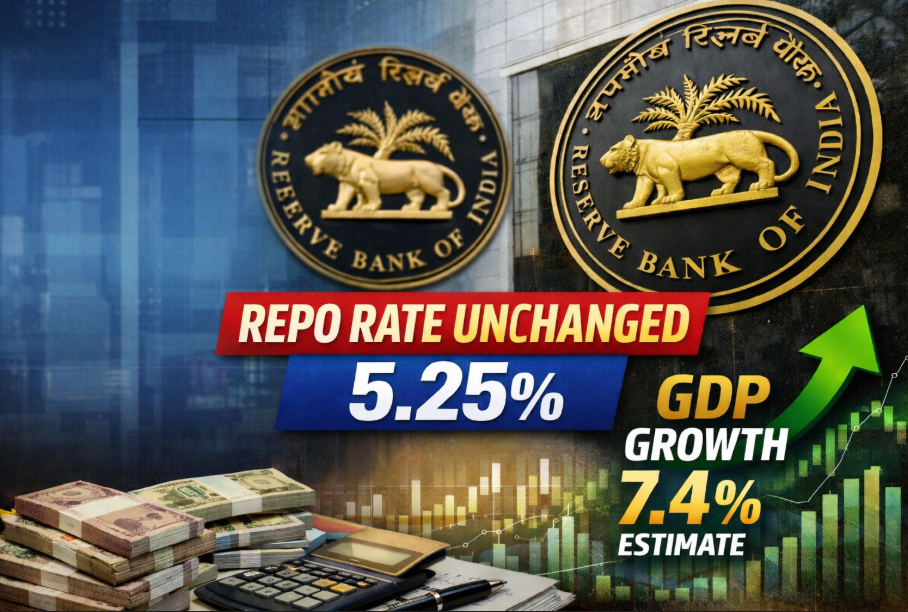
RBI Governor Sanjay Malhotra said the decision reflects the central bank’s confidence in India’s economic stability. He also projected that India’s gross domestic product (GDP) will grow by 7.4% during the current financial year.
First Policy Review of the Financial Year
This was the first monetary policy review conducted by the RBI this year, making it a closely watched event among investors, banks, and borrowers. While some market participants expected a further rate cut, the RBI chose to maintain the existing policy stance.
According to the central bank, the current interest rate level is appropriate to support economic growth while keeping inflation under control.
What Is the Repo Rate?
The repo rate is the interest rate at which the RBI lends short-term funds to commercial banks. It plays a key role in determining lending and deposit rates across the banking system.
- When the repo rate rises, loan interest rates usually increase
- When it falls, borrowing becomes cheaper
- When it remains unchanged, interest rates tend to stay stable
As a result, RBI decisions on the repo rate directly affect home loans, car loans, personal loans, and business borrowing costs.
Why RBI Chose to Keep Rates Unchanged
The RBI’s decision was influenced by several factors:
Stable Inflation
Inflation remains largely within manageable levels. Since price pressures are not severe, the RBI did not find it necessary to raise interest rates.
Steady Economic Growth
Economic indicators point to consistent growth across sectors such as manufacturing, services, and consumption.
Global Uncertainty
Ongoing global challenges, including geopolitical tensions and fluctuating crude oil prices, have prompted the RBI to take a cautious approach.
Impact of Previous Rate Cuts
Last year, the RBI revised interest rates multiple times. Between February 2025 and December 2025, the repo rate was reduced by 1.25 percentage points. These cuts are still working their way through the economy.
Interest Rate Changes in the Previous Year
During the previous financial year, the RBI adjusted interest rates several times to support growth and ease financial conditions.
Those measures helped:
- Reduce loan EMIs for borrowers
- Improve liquidity in the banking system
- Encourage investment and consumption
The central bank now wants to assess the full impact of those changes before making any further moves.
GDP Growth Outlook Remains Strong
The RBI’s projection of 7.4% GDP growth reflects optimism about India’s economic prospects.
Growth is expected to be driven by:
- Strong domestic demand
- Government spending on infrastructure
- Continued expansion in services and manufacturing
This growth forecast places India among the fastest-growing major economies globally.
Impact on Borrowers and Consumers
Home Loan Borrowers
With the repo rate unchanged, home loan EMIs are expected to remain stable in the near term.
Personal and Auto Loans
Interest rates on personal and vehicle loans are also likely to stay at current levels.
Savings and Fixed Deposits
Deposit rates may remain steady, offering predictability for savers and long-term investors.
Impact on Banks and Businesses
For banks, policy stability allows better planning of lending activities and credit growth. Businesses, especially small and medium enterprises, benefit from predictable borrowing costs.
Stable interest rates also support investment decisions and overall economic confidence.
What Lies Ahead?
The RBI has indicated that future policy decisions will depend on:
- Inflation trends
- Global economic developments
- Domestic demand conditions
- Agricultural and monsoon performance
Any changes to interest rates will be based on incoming data rather than fixed timelines.
Conclusion
By keeping the repo rate unchanged at 5.25%, the RBI has chosen stability over aggressive action. With inflation under control and GDP growth expected at 7.4%, the central bank sees no immediate need for a policy shift.
For borrowers, businesses, and investors, the decision provides clarity and confidence as the financial year begins. The RBI’s cautious stance signals a focus on sustainable growth and long-term economic stability.